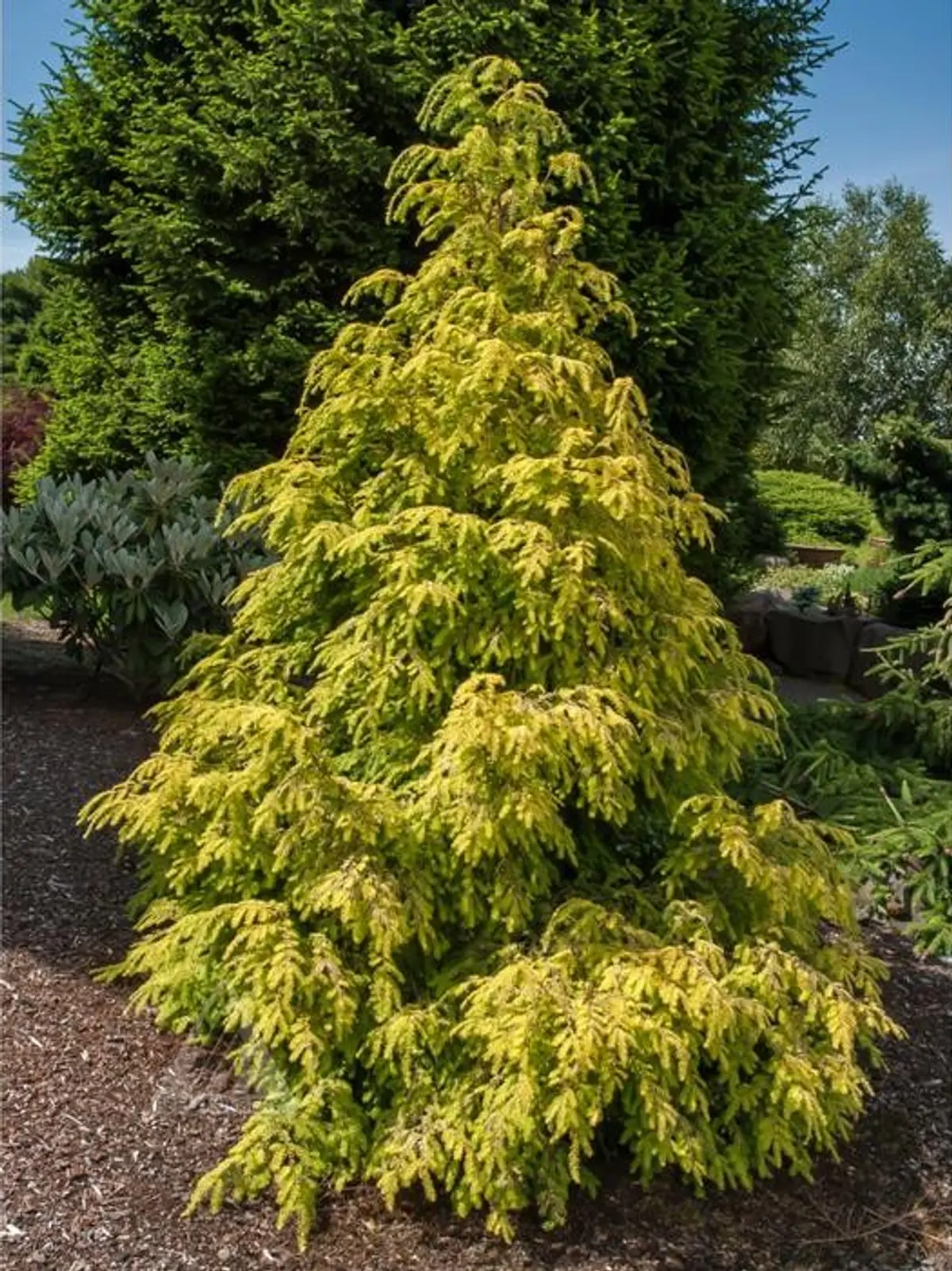
Canadian Hemlock 'Golden Splendor'
Tsuga canadensis 'Golden Splendor'
A fast-growing, graceful hemlock with bright golden foliage that tolerates more sun than other golden cultivars.
Keep reading Show less
‘Golden Splendor’ resembles the native Canadian (eastern) hemlock in all but color: its foliage is golden. It was introduced by John Mitsch of Aurora, Oregon, and grows more than 15 in. per year to about 25 ft tall and 15 ft wide, hardy to zone 4.
Through the seasons
Bright golden-yellow, softly drooping foliage glows year-round. It tolerates full sun and produces brighter color with more exposure. Planted in a row, it can be sheared into a golden hedge.
Care tips
Plant in moist but well-drained, somewhat acidic soil in sun to part shade. It grows best where summers are cool and does not tolerate drought. Check the undersides of branches for the white, cottony egg masses of hemlock woolly adelgid, a major pest.
Care sources: Iseli Nursery, NC State Extension.
Pet-safety source: ASPCA Poison Control.
Fun Fact
Despite its name, Canadian hemlock is a conifer unrelated to the poisonous herb called poison hemlock.
Habitat & form
Where it's from and what to expect.
- Native range
- Eastern and central Canada and the United States (species); cultivated selection
- Plant type
- Tree · Perennial · Conifer
- Mature size
- About 25 ft tall and 15 ft wide at maturity; fast growing at 15+ in. per year, broad and upright.
- Bloom
- Not grown for flowers; ornamental value is the golden foliage and graceful drooping habit.
- Hardiness
- USDA zone 4.
Care
How to keep it happy.
- Sunlight
- Sun to part shade; more sun brightens foliage. Protect from hot afternoon sun and drying wind.
- Water
- Consistent moisture; does not tolerate drought. Mulch and water in dry spells.
- Soil
- Moist but well-drained, somewhat acidic soil.
- Fertilizer
-
Use Espoma Holly-tone only when soil is nutrient-deficient.
Late winter to early spring
- Planting distance
- About 15 ft wide at maturity, so allow 8–15 ft depending on hedge or specimen use.
- Propagation
- Cultivars are grafted or rooted from cuttings; seed-grown plants do not come true.
- Pruning
- Usually best left unpruned, but tolerates shearing into a hedge. If shaping, prune in late spring to early summer.
- Pet safety
- Non-toxic
Discourage chewing.