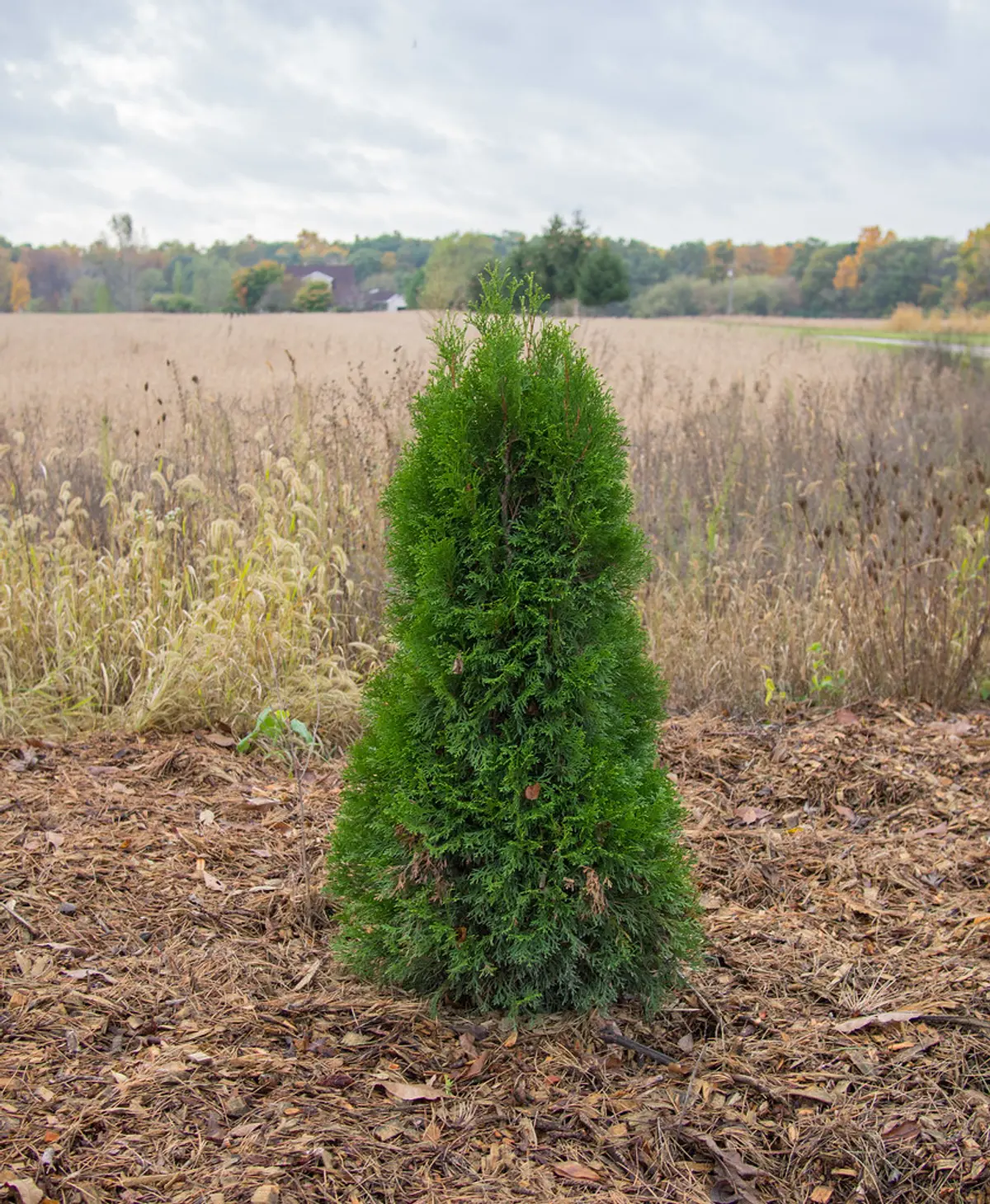
Emerald Arborvitae
Thuja occidentalis 'Emerald'
A narrow, conical evergreen prized as a low-maintenance hedge, screen, or specimen with dense, year-round green foliage.
Keep reading Show less
The American arborvitae is a dense, conical evergreen in the cypress family, and the cultivar ‘Emerald’ (also sold as ‘Smaragd’) is one of the most popular for its narrow, upright form and bright green foliage that holds its color well through the seasons. Its tidy shape and easy nature make it a go-to for hedges, screens, and windbreaks.
A living wall
Planted in a row, ‘Emerald’ forms a neat, dense green screen that needs little pruning. Its dense crown also offers cover and nesting sites for birds.
Care tips
Give it full sun to part shade — in deep shade the foliage thins out. It appreciates consistent moisture and tolerates clay, wet soil, and urban pollution.
Heads up: deer browsing can be a serious problem for arborvitae, so protect young plants where deer pressure is high.
Fun Fact
'Arborvitae' is Latin for 'tree of life'.
Habitat & form
Where it's from and what to expect.
- Native range
- Eastern North America
- Plant type
- Tree · Shrub · Perennial · Conifer
- Mature size
- 10–15 ft tall and 3–4 ft wide; slow-growing, narrow column.
- Bloom
- A needled evergreen with yellowish-green foliage that bronzes in winter; small light-brown cones.
- Hardiness
- USDA zones 3–7.
Care
How to keep it happy.
- Sunlight
- Full sun to partial shade; foliage thins in full shade.
- Water
- Prefers high soil and atmospheric moisture; tolerates wet ground but not dry sites.
- Soil
- Clay or loam with neutral to alkaline pH; good drainage to consistently moist.
- Fertilizer
-
Use Espoma Plant-tone only when soil is nutrient-deficient.
Late winter to early spring
- Planting distance
- 2–4 ft apart for a hedge; wider (5–6 ft) for individual specimens.
- Propagation
- Semi-hardwood cuttings
- Pruning
- Shape lightly in spring or early summer. Cut only into green growth; bare brown branches will not resprout.
- Pet safety
- Unknown
Prevent chewing; contact a veterinarian after ingestion.