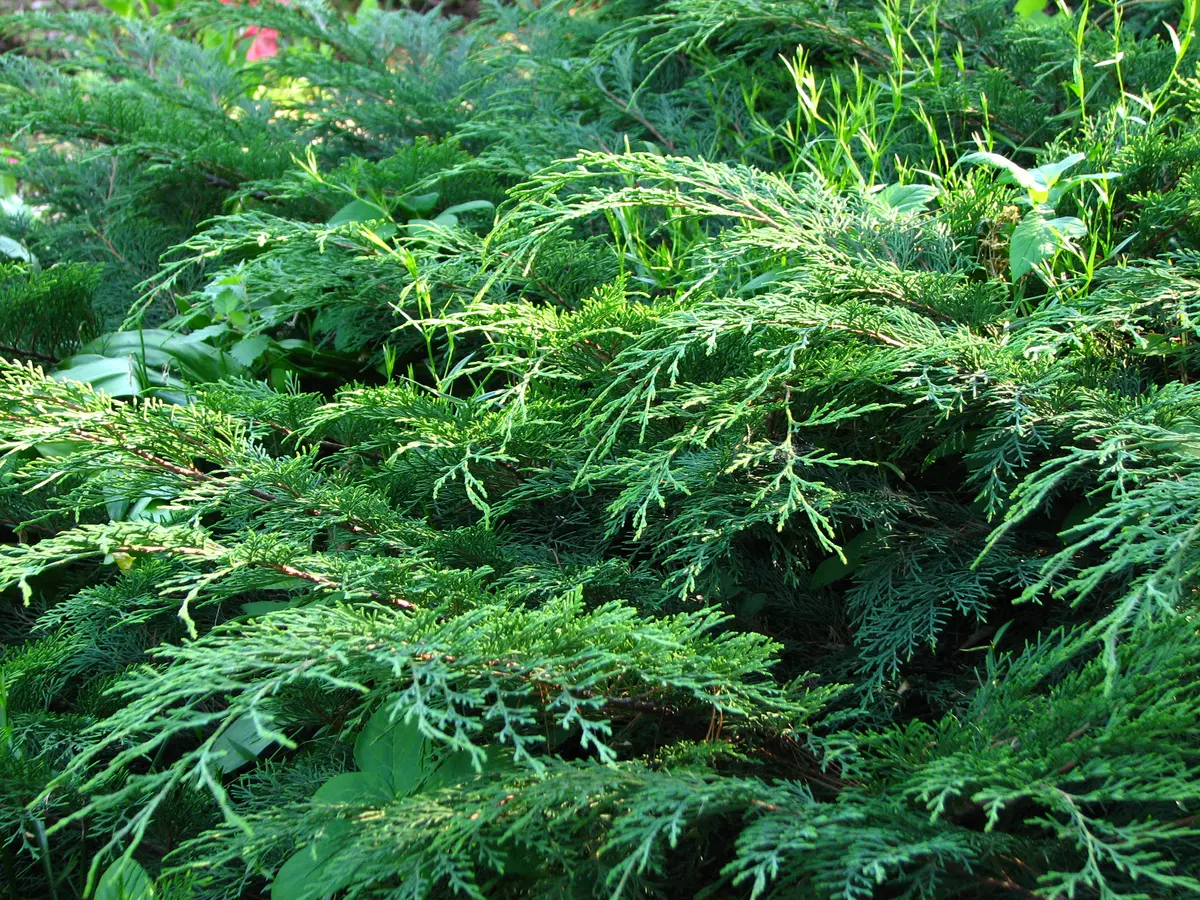
Siberian Cypress 'Celtic Pride'
Microbiota decussata 'Celtic Pride®'
A super-hardy, low, spreading evergreen conifer that forms a feathery green ground cover and turns bronze-purple in winter.
Keep reading Show less
Siberian cypress, also called Russian arborvitae, is a dwarf, evergreen conifer endemic to the Sikhote-Alin mountains of far-eastern Russia, where it grows as a ground-hugging shrub above the treeline. In the garden it forms a dense, spreading carpet of soft, feathery foliage with indefinitely lengthening stems that nod gently at the tips — one of the toughest and most reliable conifer ground covers for cold climates.
Through the seasons
The scale-like leaves are arranged in flat, fan-like sprays reminiscent of arborvitae, giving the whole plant a soft, textured look. Foliage is bright green through spring and summer, then shifts to an attractive bronze-purple as temperatures drop, adding real winter interest to a bed that would otherwise look bare. Tiny, spherical, berry-like cones appear but are easy to miss — this plant’s appeal is entirely about its foliage and form.
Care tips
Siberian cypress asks for very little: plant it in well-drained soil (it will not tolerate “wet feet”) in full sun to part shade, and otherwise leave it alone. It performs best in cooler summer climates and can struggle where summers are hot and humid. Because it tolerates more shade than most ground-cover junipers, it’s a useful alternative wherever a low, spreading evergreen is needed on a bank, slope, rock garden, or foundation planting that doesn’t get all-day sun.
Heads up: Good drainage is the one non-negotiable. Root rot in waterlogged soil is by far the most common way to lose this otherwise nearly indestructible plant.
Fun Fact
This ground-hugging conifer grows wild above the timberline on remote Russian mountain peaks and stayed almost unknown in the West until the 1970s, when its native range was still a closely guarded secret.
Habitat & form
Where it's from and what to expect.
- Native range
- Sikhote-Alin mountains of far-eastern Russia (species); this cold-hardy selection is a garden cultivar
- Plant type
- Conifer
- Mature size
- 1–3 ft tall, spreading to fill a 4–5 ft area.
- Bloom
- Non-flowering; tiny, inconspicuous berry-like cones appear on the feathery, scale-like foliage. Bright green in summer, turning bronze-purple in fall and winter.
- Hardiness
- USDA zones 2–7 (cultivar is more cold hardy than the species, rated to zone 3 by most growers).
Care
How to keep it happy.
- Sunlight
- Full sun to part shade — more shade tolerant than most ground-cover conifers.
- Water
- Medium — keep soil consistently moist but never soggy.
- Soil
- Average, well-drained soil is essential; poorly drained sites lead to root rot.
- Planting distance
- 4–5 ft apart, allowing room for the spreading habit.
- Propagation
- Semi-hardwood cuttings in summer, or seed sown in autumn.
- Pruning
- Very low maintenance — regular pruning is not required. Trim only to control spread or remove damaged growth.
- Pet safety
- Non-toxic