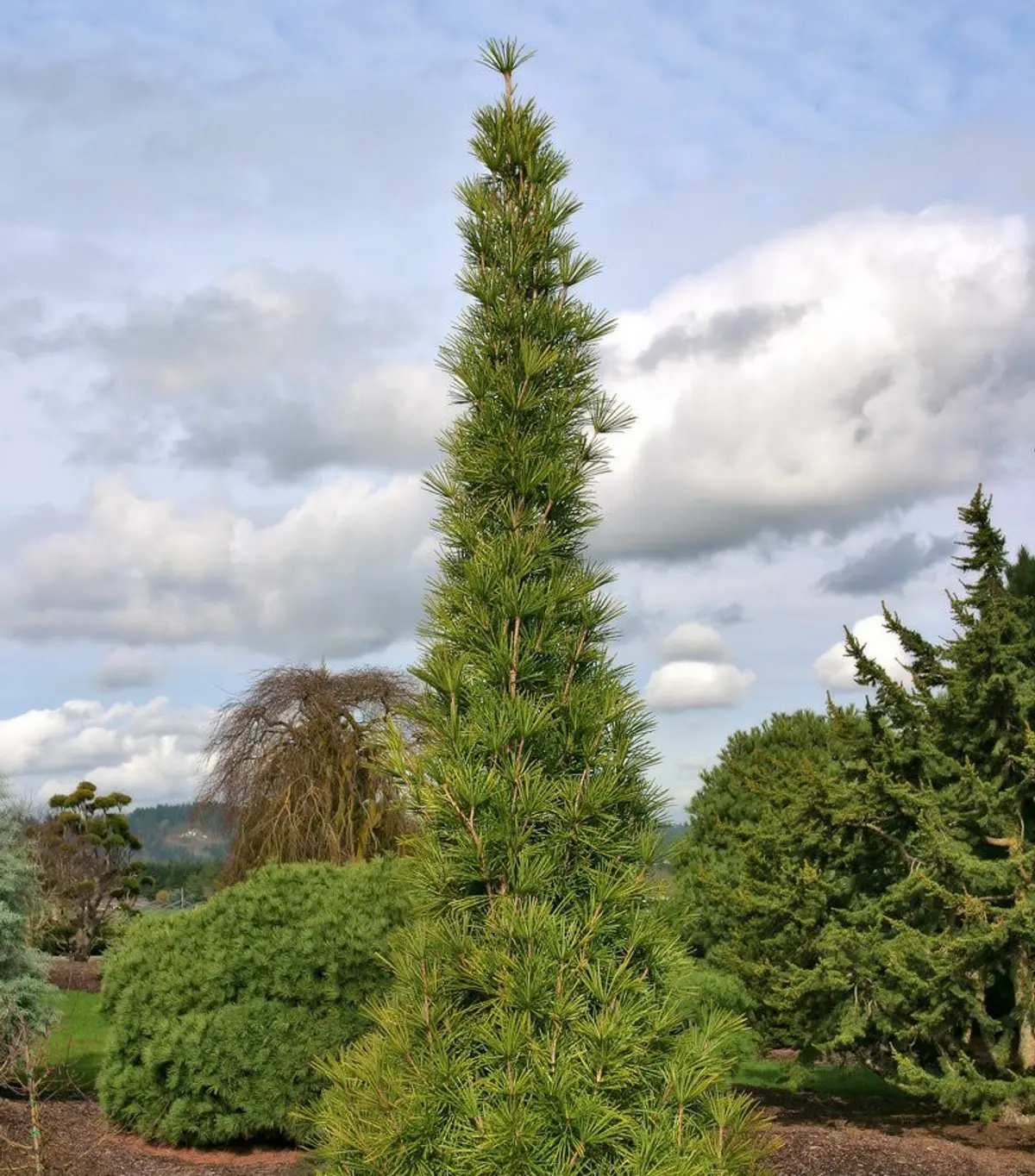
Japanese Umbrella Pine 'Joe Kozey'
Sciadopitys verticillata 'Joe Kozey'
A narrow, spire-shaped evergreen with glossy needles arranged in umbrella-like whorls and sturdy, upright branches.
Keep reading Show less
‘Joe Kozey’ is a narrow, upright selection of Japanese umbrella pine, introduced by Sidney Waxman at the University of Connecticut. At 20 ft tall it is only about 6 ft wide, with sturdy branches held tight to the trunk that can withstand heavy snow loads.
Through the seasons
It is evergreen: glossy green needles in whorls give a year-round, spire-like silhouette that grows slowly into a large tree. Reddish-brown bark that exfoliates in strips adds interest on older trees.
Care tips
Plant in rich, moist, well-drained, slightly acidic soil in sun or part shade, sheltered from harsh winter wind. Keep the soil consistently moist; it does best in cool summers and appreciates afternoon shade in hot climates.
Care sources: Oregon State, NC State Extension.
Pet-safety source: Van den Berk.
Fun Fact
Umbrella pine is the only living member of its plant family, Sciadopityaceae, and its long needles are arranged in whorls like the spokes of an umbrella.
Habitat & form
Where it's from and what to expect.
- Native range
- Japan (species); cultivated selection
- Plant type
- Tree · Perennial · Conifer
- Mature size
- About 6 ft wide when 20 ft tall; grows roughly 12–15 in. per year.
- Bloom
- Not grown for flowers; grown for its whorled needle foliage and narrow form.
- Hardiness
- USDA zone 5.
Care
How to keep it happy.
- Sunlight
- Full sun to part shade; appreciates afternoon shade in very hot summers.
- Water
- Consistent moisture; not drought tolerant. Mulch the roots.
- Soil
- Rich, moist, well-drained, slightly acidic soil.
- Fertilizer
-
Use Espoma Holly-tone only when soil is nutrient-deficient.
Late winter to early spring
- Planting distance
- Allow at least 6 ft of width.
- Propagation
- Cultivars are grafted; the species is slow to root from cuttings or seed.
- Pruning
- Little pruning needed; remove dead or damaged branches.
- Pet safety
- Unknown
Keep pets from chewing.