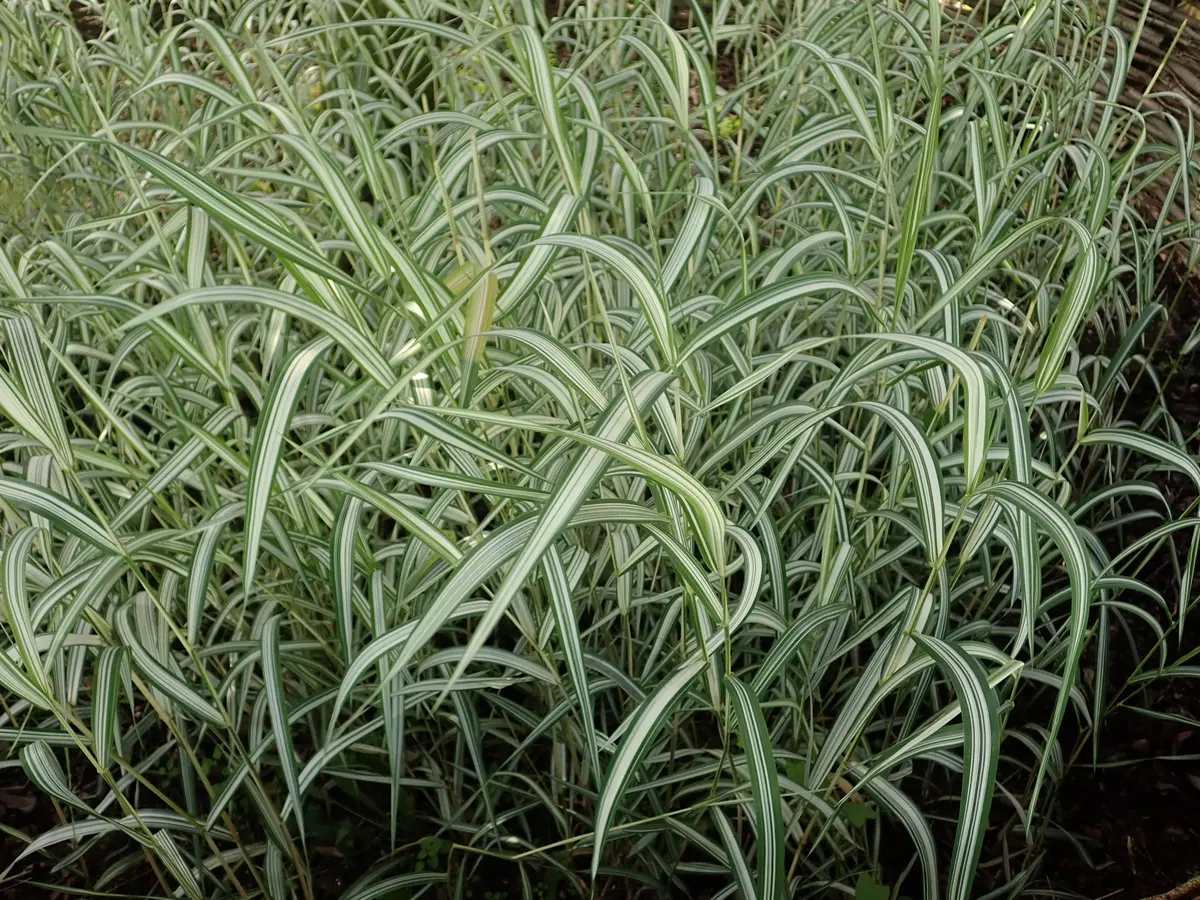
Ribbon Grass
Phalaris arundinacea 'Picta'
A bright, indestructible spreading grass whose upright blades are striped lengthwise in crisp white and green — a vigorous groundcover for sun or shade, damp ground or dry.
Keep reading Show less
Phalaris arundinacea ‘Picta’ — ribbon grass or gardener’s garters — is a rhizomatous perennial grass (Poaceae) grown for its boldly variegated foliage: upright blades striped lengthwise in white and green that brighten a border, a damp margin or a difficult dry corner. It is one of the toughest, most adaptable ornamentals you can plant.
Foliage, not flowers
The summer flower panicles are slim and forgettable; the point of this grass is the crisp white-and-green striping, which reads almost silver from a distance and lights up shade. In cool spring weather the new growth often carries a pink flush before settling to white and green.
Care tips — and a warning
Ribbon grass will grow almost anywhere, which is both its strength and its catch: it spreads vigorously by underground rhizomes and the plain green wild form is an aggressive wetland invader. Plant ‘Picta’ where you can contain it — a sunken pot, a bed bounded by paving, or a spot you actively want covered — and avoid letting it escape near natural waterways. Cut it to the ground in late winter, and shear it back midseason if the leaves brown to bring on fresh foliage. Beyond keeping it in bounds, it asks for nothing.
Fun Fact
Ribbon grass is one of the oldest cultivated ornamental grasses, grown in gardens for centuries. Its old country name, gardener's garters, comes from the way the long striped blades look just like lengths of ribbon.
Habitat & form
Where it's from and what to expect.
- Native range
- Temperate Europe, Asia and North America
- Plant type
- Ornamental grass
- Mature size
- About 2–3 ft tall in leaf (taller in flower) and spreading indefinitely by rhizomes.
- Bloom
- Thin, airy panicles of pale pink-and-white flowers in summer — incidental; this grass is grown entirely for its striped foliage.
- Hardiness
- USDA zones 3–9.
Care
How to keep it happy.
- Sunlight
- Full sun to partial shade. Variegation is brightest in sun; a little afternoon shade prevents midsummer scorch.
- Water
- Adaptable. Thrives in everything from average garden soil to pond margins and shallow standing water, yet is very drought tolerant once established.
- Soil
- Almost any soil, wet or dry, rich or poor.
- Planting distance
- 24–36 in apart (it spreads aggressively by rhizomes — consider a root barrier).
- Propagation
- Divide in spring
- Pruning
- Cut to the ground in late winter. If the foliage tires and browns in summer heat, shear it back hard to force a fresh flush of clean new blades. Contain the roots — it spreads aggressively.
- Pet safety
- Non-toxic