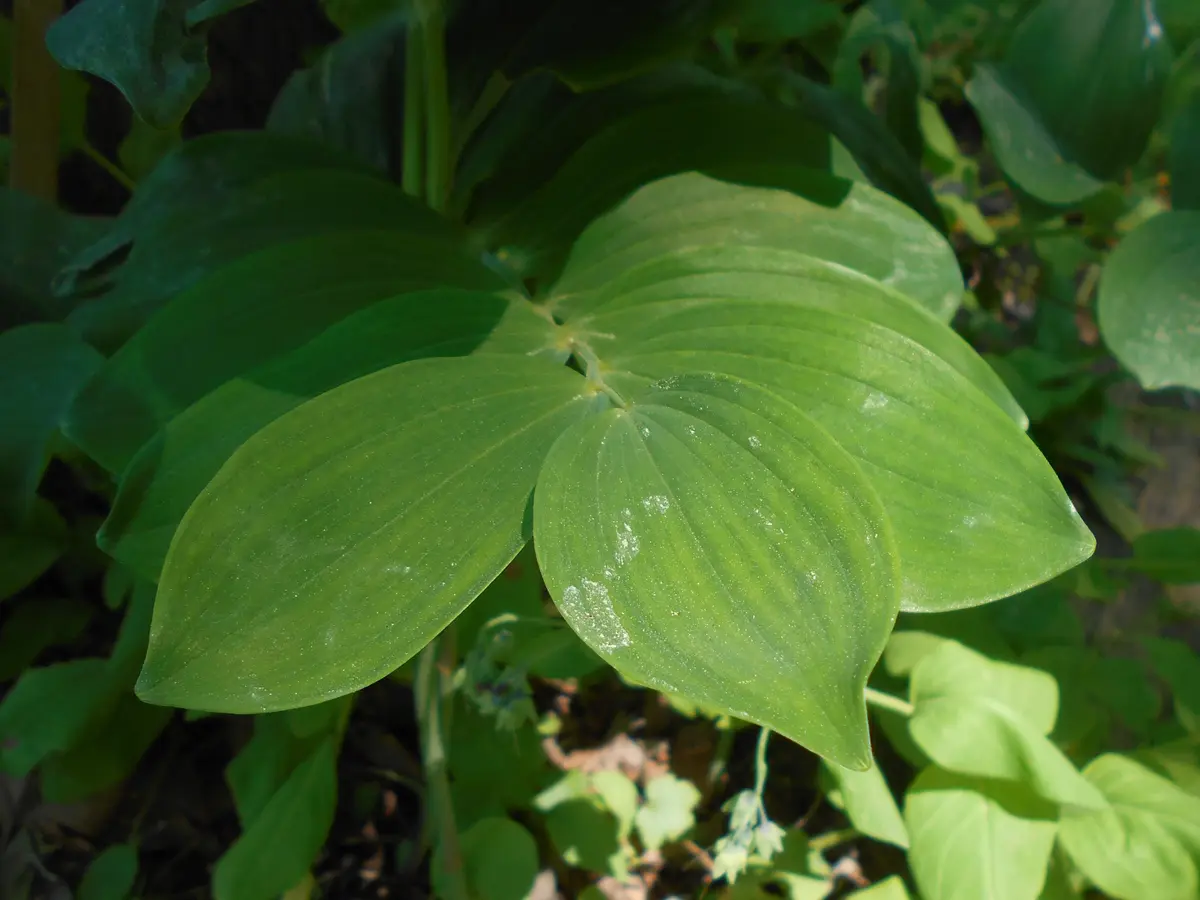
Giant Solomon's Seal
Polygonatum biflorum var. commutatum
A bold native woodland perennial with tall, arching stems lined with broad leaves and rows of dangling, greenish-white bell-shaped flowers.
Keep reading Show less
Polygonatum biflorum var. commutatum — giant Solomon’s seal — is a native herbaceous perennial of moist eastern woodlands and the largest of the Solomon’s seals, reaching 3 to 5 feet and occasionally as much as 7. Tall, gracefully arching stems carry broad, parallel-veined leaves with rows of greenish-white, bell-shaped flowers dangling beneath them in late spring.
Woodland presence
This is a plant for the back of a shady border, a woodland or rain garden, or a spot where it can naturalize. Just give it plenty of room — it spreads slowly by rhizomes and grows larger than other Solomon’s seals. In fall the flowers give way to showy blue-black berries (inedible to people, but loved by birds).
Care tips
Plant it in average, moist to wet soil in partial to full shade; it does best with a little sun. It has no serious pest or disease problems and asks for very little once established.
Fun Fact
Old stems leave seal-like circular scars on the rhizome, giving Solomon's seal its name.
Habitat & form
Where it's from and what to expect.
- Native range
- Eastern and central North America
- Plant type
- Perennial
- Mature size
- 3–6 ft tall (occasionally to 7 ft) and 2–4 ft wide; spreads gradually by rhizomes.
- Bloom
- Clusters of 2–10 greenish-white, bell-shaped flowers hang beneath the stems in May–June, followed by showy blue-black berries in fall.
- Hardiness
- USDA zones 3–9.
Care
How to keep it happy.
- Sunlight
- Partial to full shade, though it does best with some sun. Tolerates deep shade.
- Water
- Medium to wet; keeps best in consistently moist soil.
- Soil
- Average soil with good drainage that stays moist.
- Planting distance
- 12–18 in apart; clumps spread and merge into larger colonies over time.
- Propagation
- Divide rhizomes in spring or fall
- Pruning
- Maintenance: minimal — let the foliage die back and cut the spent stems to the ground in fall. Lift and divide the rhizomes in fall to rejuvenate or contain the clump.
- Pet safety
- Unknown
Prevent chewing; contact a veterinarian after ingestion.