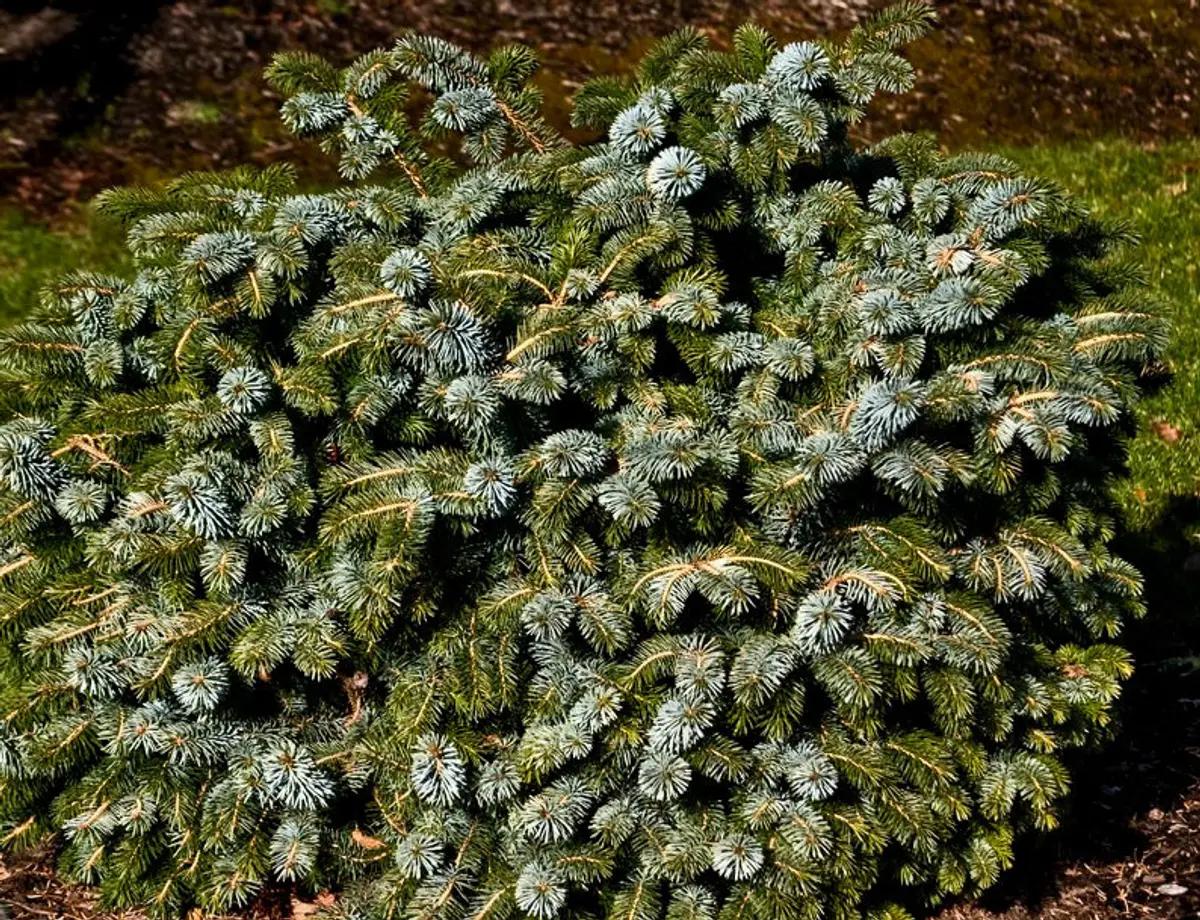
Sitka Spruce 'Silberzwerg'
Picea sitchensis 'Silberzwerg'
A very slow-growing dwarf conifer prized for its striking two-tone foliage — silvery-blue above, dark green beneath — that forms a dense, broadly upright mound over many years.
Keep reading Show less
Picea sitchensis ‘Silberzwerg’ is a dwarf form of Sitka spruce — a species that, in the wild, ranks among the tallest conifers on the planet — bred down into a dense, slow-growing mound for small gardens and containers. Its claim to fame is its foliage: each needle is a striking two-tone, silvery-blue on the upper surface and dark green beneath, giving the whole plant a shimmering, frosted look that shifts with the light and the angle you view it from.
A tiny fraction of a giant
In the wild, Sitka spruce grows along a narrow strip of the Pacific coast from Alaska to northern California, rarely straying far from the ocean’s moderating influence, and can exceed 200 feet. ‘Silberzwerg’ inherits none of that scale — it creeps along at just 3 to 6 inches a year, taking on a broad, upright habit and reaching only about 8 feet tall and 6 feet wide after decades in the garden, making it a genuine dwarf conifer rather than simply a “slow” one.
Care tips
Plant in full sun in moist, well-drained, slightly acidic soil for the densest growth and best color; it will tolerate some afternoon shade but grows looser there. Water regularly while it establishes, keep it out of soggy, poorly drained spots, and otherwise leave it be — pruning is limited to removing any dead or damaged wood. Watch for spruce aphids, adelgids, and spider mites, which can occasionally trouble this species.
Fun Fact
The wild species behind this dwarf, Sitka spruce, is one of the tallest trees on Earth, regularly topping 200 ft along the foggy Pacific coast. 'Silberzwerg' ('silver dwarf' in German) packs the same striking silvery-blue needles into a mound just a few feet across.
Habitat & form
Where it's from and what to expect.
- Native range
- Garden cultivar of the species native to the Pacific coast of North America, from south-central Alaska to northern California
- Plant type
- Conifer
- Mature size
- Extremely slow, growing only 3–6 in. per year; reaches roughly 8 ft tall and 6 ft wide after many years in the garden — a tiny fraction of the wild species' size.
- Bloom
- None — grown for its evergreen, two-tone needles rather than flowers.
- Hardiness
- USDA zone 5 (some sources list zones 5–8).
Care
How to keep it happy.
- Sunlight
- Full sun for the densest growth and best needle color; tolerates partial shade.
- Water
- Regular water while young; more drought-tolerant once established, but appreciates consistent moisture in hot weather.
- Soil
- Moist, well-drained soil, slightly acidic to neutral (pH about 6.5–7.5). Dislikes heavy, poorly drained ground.
- Planting distance
- 5–6 ft apart, based on mature spread.
- Propagation
- Semi-hardwood cuttings
- Pruning
- Maintenance: very low. Remove only dead or damaged wood; no routine shaping needed.
- Pet safety
- Non-toxic