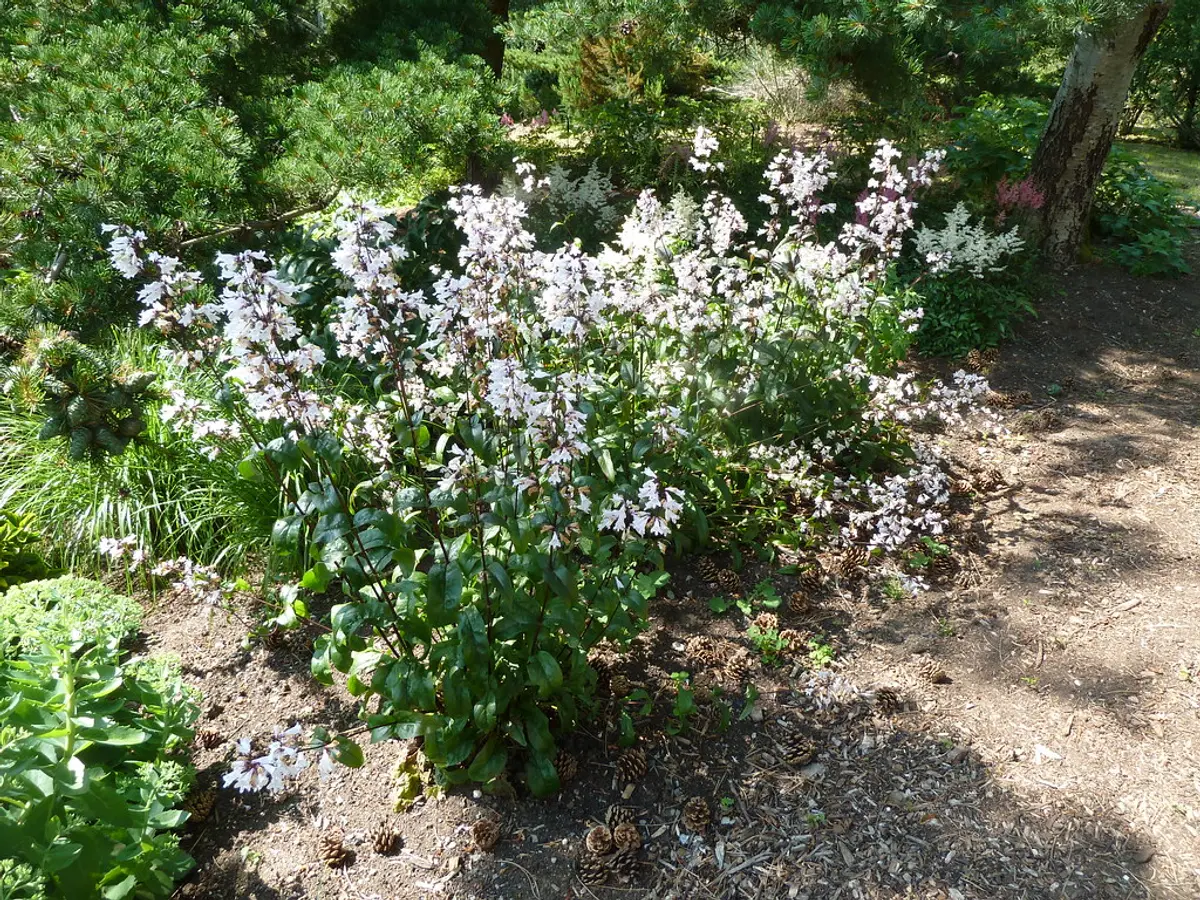
Beardtongue 'Husker's Red'
Penstemon digitalis 'Husker's Red'
A tough native beardtongue grown for its dramatic maroon-red foliage and stems, topped in early summer by airy panicles of white, pink-blushed tubular flowers that bees and hummingbirds work over.
Keep reading Show less
Penstemon digitalis ‘Husker’s Red’ is a clump-forming herbaceous perennial in the plantain family (Plantaginaceae), a selection of the wild foxglove beardtongue native to eastern and central North America. Its signature feature is colour: the new foliage emerges deep maroon in spring, ages to green veined with maroon, and the wiry flower stems stay a glossy burgundy all season — a striking foil for the flowers.
Early-summer bloom
In late spring to early summer, branching panicles open dozens of white, two-lipped tubular flowers, often blushed pink with fine purple nectar lines inside the lower lip. The tube is perfectly sized for bees and hummingbirds. After the petals drop, the rust-coloured seed capsules carry interest well into winter.
Care tips
This is an easy, drought-tolerant native once established. Give it full sun and well-drained soil — the foliage colours best in sun, and good drainage prevents the winter root rot that is its only real weakness. Leave the seed heads standing through winter, cut back in late winter, and divide every few years. Deer leave it alone, and it earns its keep in pollinator beds, cottage borders, rock gardens and naturalized plantings.
Fun Fact
'Husker's Red' was selected at the University of Nebraska — home of the Cornhuskers — and in 1996 it became the first Penstemon ever named Perennial Plant of the Year. Penstemon is also the largest genus of flowering plants found only in North America.
Habitat & form
Where it's from and what to expect.
- Native range
- Eastern and central North America (the species)
- Plant type
- Perennial
- Mature size
- Basal foliage clump 12–18 in. across; flowering stems rise 2–3 ft tall and about 18 in. wide.
- Bloom
- Open panicles of white, lightly pink-blushed tubular flowers in late spring to early summer. Ornamental seed heads follow.
- Hardiness
- USDA zones 3–8.
Care
How to keep it happy.
- Sunlight
- Full sun for the deepest foliage colour; tolerates light shade.
- Water
- Moderate while establishing, then drought tolerant. Wet winter soils are the main enemy — they cause root rot.
- Soil
- Average to dry, well-drained soil; adapts to most textures and pH as long as drainage is good.
- Planting distance
- 12–18 in apart.
- Propagation
- Stem cuttings in summer
- Pruning
- Low maintenance. Leave the rusty winter seed heads for interest, then cut old stems back in late winter. Divide clumps every few years to keep them vigorous.
- Pet safety
- Non-toxic