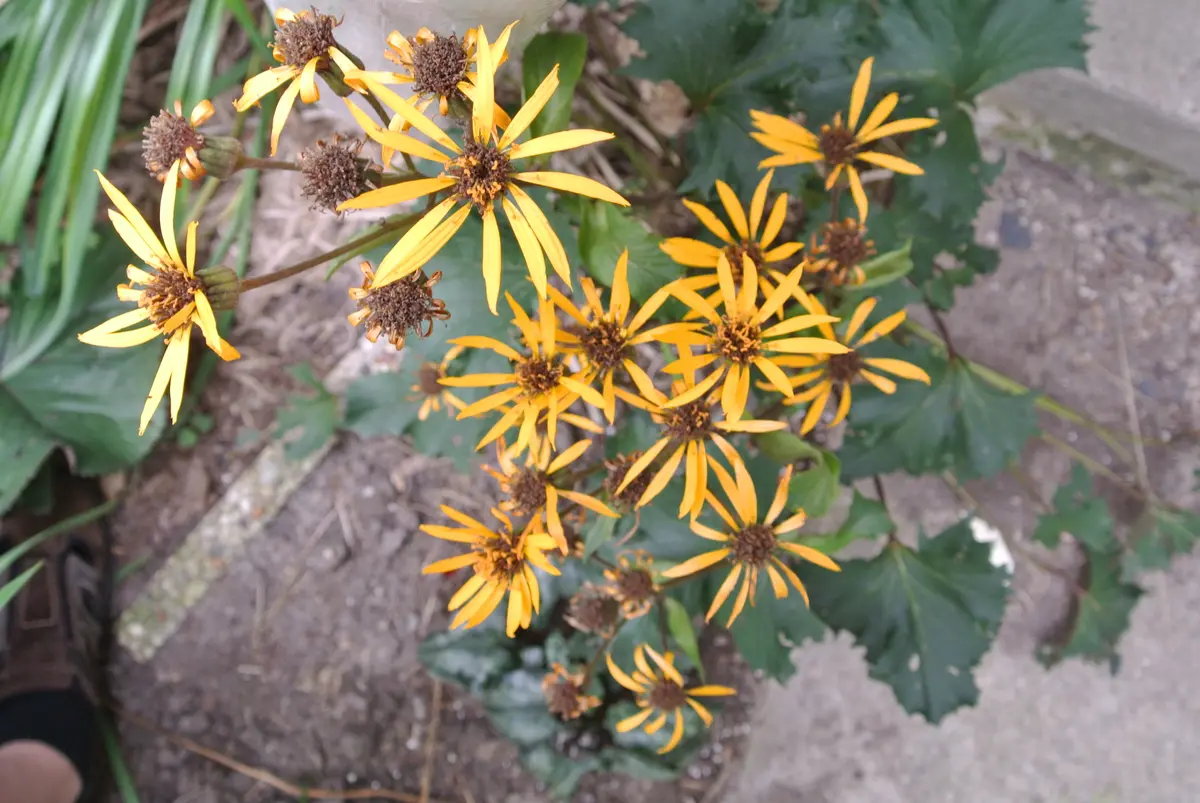
Leopard Plant 'Osiris Fantaisie'
Ligularia dentata 'Osiris Fantaisie'
A compact, clump-forming leopard plant selection with thick, leathery, burgundy-backed leaves and orange-yellow daisy flowers on reddish-purple stems in late summer.
Keep reading Show less
Ligularia dentata ‘Osiris Fantaisie’ is a patented cultivar (U.S. Plant Patent PP19,302) of leopard plant, bred by Serge Farard of Les Jardins Osiris in Quebec, Canada. Like the species — a clump-forming perennial in the daisy family native to moist mountain woodlands of China and Japan — it is grown as much for its dramatic foliage as its flowers, but in a more compact package than the straight species.
Bold foliage, bright flowers
Thick, leathery, deeply veined leaves with incised, undulating margins are dark green above and burgundy underneath, forming a basal mound up to 24 in tall and wide. In mid- to late summer, reddish-purple stems rise above the foliage carrying loose clusters of bright orange-yellow daisy flowers 2–3 in across, drawing bees and butterflies.
Care tips
This is a plant for the moist, shady corner. Give it rich soil that never dries out — a pond or stream edge is ideal — and shelter from hot afternoon sun, which makes the leaves wilt dramatically (they recover once watered or as the sun moves off). Deadhead spent stalks and cut the foliage back after frost.
Habitat & form
Where it's from and what to expect.
- Native range
- China and Japan (species); cultivar bred in Quebec, Canada
- Plant type
- Perennial
- Mature size
- Foliage mound to 24 in tall and wide; flower stems raise total height to 30–36 in.
- Bloom
- Daisy-like, yellow-orange flowers (2–3 in across) in loose clusters on reddish-purple stems, mid- to late summer.
- Hardiness
- USDA zones 4–8.
Care
How to keep it happy.
- Sunlight
- Part shade to full shade. Give it afternoon shade — full sun is fine only where the soil stays reliably wet.
- Water
- Thirsty — keep the soil consistently moist. It wilts dramatically in midday heat or dry soil, recovering once watered or as the sun moves off.
- Soil
- Rich, humusy, moisture-retentive soil; tolerates clay and grows happily at a pond or stream edge.
- Planting distance
- 18–24 in apart.
- Propagation
- Divide in spring
- Pruning
- Maintenance: low. Deadhead spent flower stalks, then cut the foliage back after frost.
- Pet safety
- Non-toxic