Leopard Plant 'Bottle Rocket'
Ligularia 'Bottle Rocket'
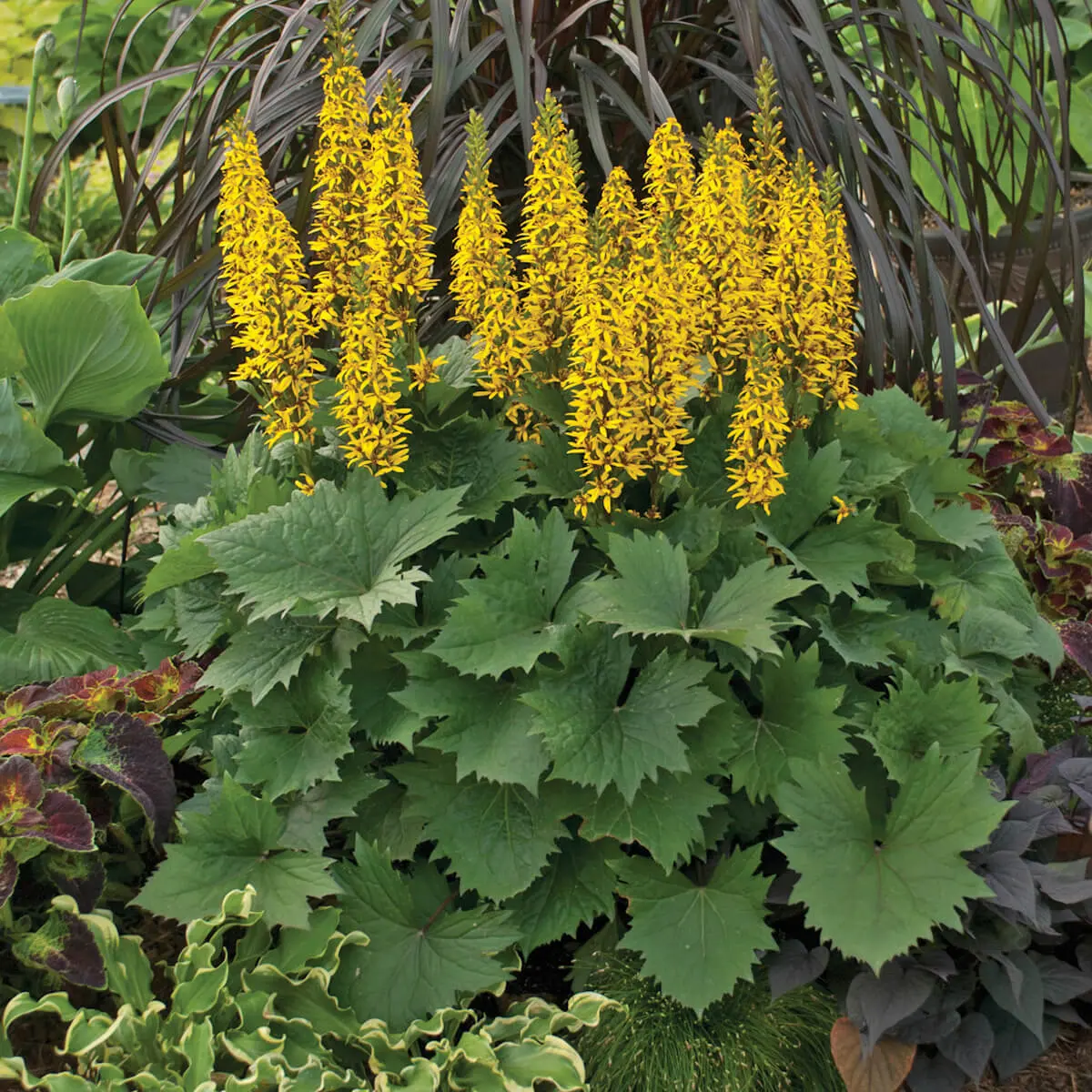
A patented Ligularia selection with bold, toothed foliage and dense, bottlebrush-like spikes of mustard-yellow flowers held on dark stems in late summer.
Keep reading Show less
Ligularia ‘Bottle Rocket’ is a patented, compact selection prized for its dense clumps of large, dark green, serrated leaves and its striking flower display: tight, upright spikes of mustard-yellow blooms held on nearly black stems, standing just above the foliage like a bouquet of tiny rockets. It’s a sport of the taller ‘Little Rocket’, discovered in the growing fields at Walters Gardens in 2006.
A bold accent for damp shade
Like all Ligularia, ‘Bottle Rocket’ wants constantly moist, rich soil and a sheltered spot in part to full shade — hot midday sun or drying wind will cause even well-watered plants to wilt dramatically by afternoon (though they usually recover by evening). Its bold, tropical-looking foliage and colorful spikes make it a natural fit for pond edges, streamsides, rain gardens, and shaded borders where moisture is reliable.
Care tips
Plant in rich, humusy soil that stays evenly moist — never let it dry out — and give it protection from strong sun and wind. Watch for slugs and snails, which can significantly damage the foliage; deer generally leave it alone. Divide clumps in spring or right after flowering to maintain vigor, and cut back the spent flower spikes once blooms fade.
Fun Fact
'Bottle Rocket' wasn't bred — it was discovered in 2006 as a spontaneous bud mutation (a 'sport') of Ligularia 'Little Rocket' in the growing fields at Walters Gardens, and later patented (US PP24,486). The genus name Ligularia comes from the Latin ligula, 'strap,' referring to the shape of its ray flowers.
Habitat & form
Where it's from and what to expect.
- Native range
- Parent species native to rocky cliffs, streamside meadows, and forests in China
- Plant type
- Perennial
- Mature size
- 2.5–3 ft tall and 2–2.5 ft wide.
- Bloom
- Dense, bottlebrush-like spikes of bright mustard-yellow flowers on contrasting chocolate-brown stems, held just above the foliage in mid to late summer.
- Hardiness
- USDA zones 4–9 (commonly cited for this cultivar, though not independently confirmed on a primary source).
Care
How to keep it happy.
- Sunlight
- Part shade to full shade, sheltered from wind. Tolerates more sun only with constant moisture; midday sun causes wilting even when watered well.
- Water
- Consistently moist soil that never dries out — this genus wilts quickly in dry conditions.
- Soil
- Rich, humusy, medium to wet soil; tolerates clay if kept moist.
- Planting distance
- 24–30 in apart.
- Propagation
- Divide in spring or just after flowering.
- Pruning
- Cut back spent flower spikes after blooming.
- Pet safety
- Mildly toxic
All parts, if ingested in quantity