Larch 'Varied Directions'
Larix decidua 'Varied Directions'
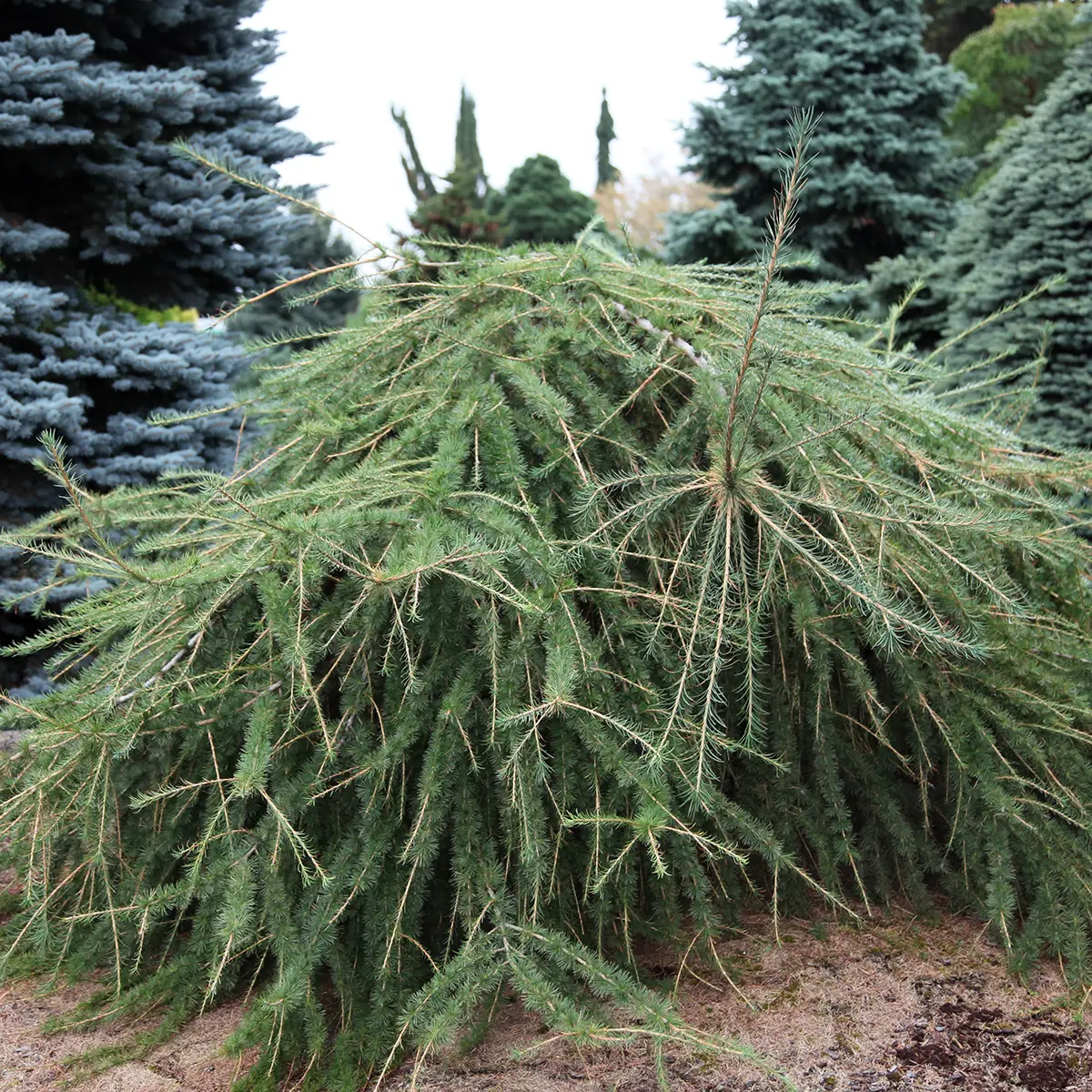
An irregular, weeping deciduous conifer whose sprawling branches change direction unpredictably, with bright green needles that turn gold and drop each fall.
Keep reading Show less
Larix decidua ‘Varied Directions’ is an unusual, irregularly weeping selection of European larch — a species native to the mountainous Alps and Carpathians, but this particular cultivar has an all-American origin, bred by University of Connecticut horticulturist Dr. Sidney Waxman. Its branches sprawl and cascade unpredictably in every direction (hence the name), giving each specimen a one-of-a-kind sculptural form.
A conifer that isn’t evergreen
Larch belongs to a small group of deciduous conifers: its soft, bright green needles hold their color through summer, then turn a brilliant gold in autumn before dropping entirely for winter — a rare “fall color” show among cone-bearing trees. Small, hairy, upright cones and inconspicuous spring cone-flowers add subtle interest the rest of the year, but the tree’s real appeal is its winding, ever-changing branch structure, especially striking against a bare winter sky.
Care tips
‘Varied Directions’ needs full sun and moist, well-drained, gravelly or sandy soil — it performs poorly in heavy clay or hot, humid conditions. Because it’s propagated by grafting, its ultimate shape depends heavily on how it’s trained and staked while young: left alone it can sprawl into a low, wide mound, while staking encourages a taller, more tree-like specimen. Give it plenty of open space to show off its form, and prune only to remove dead or crossing wood once established.
Fun Fact
Unlike most conifers, larch is deciduous — its needles turn a striking gold each autumn before dropping for winter. This particular cultivar was bred not in Europe but in Storrs, Connecticut, by University of Connecticut horticulturist Dr. Sidney Waxman, a pioneer of irregular dwarf conifer selection; the original specimen still grows on UConn's campus today.
Habitat & form
Where it's from and what to expect.
- Native range
- Central Europe (Alps and Carpathians); cultivar bred in Storrs, Connecticut
- Plant type
- Conifer
- Mature size
- Highly variable and dependent on graft height and training — commonly reaches around 8 ft tall and wide in 10 years as a staked small specimen, or sprawls low and wide if left unstaked.
- Bloom
- Not applicable — grown for foliage and form. Small reddish-pink female and yellow male cone-flowers appear in early spring, followed by small upright, hairy, reddish-brown cones.
- Hardiness
- USDA zones 2–6; struggles in hot, humid climates.
Care
How to keep it happy.
- Sunlight
- Full sun.
- Water
- Medium — moist, well-drained soil while establishing; drought-tolerant afterward, but performs poorly in hot, dry sites.
- Soil
- Well-drained, gravelly or sandy loam; acidic to neutral pH. Avoid heavy, wet clay.
- Planting distance
- Give it a wide, open, unobstructed area on all sides — at least a 6–10 ft radius — since its sculptural, irregular branching is the whole point of the cultivar.
- Propagation
- Not applicable for home gardeners — propagated commercially by grafting onto rootstock.
- Pruning
- Minimal. Shape and stake while young to establish the desired height and branch direction; thereafter just remove dead or crossing wood.
- Pet safety
- Non-toxic