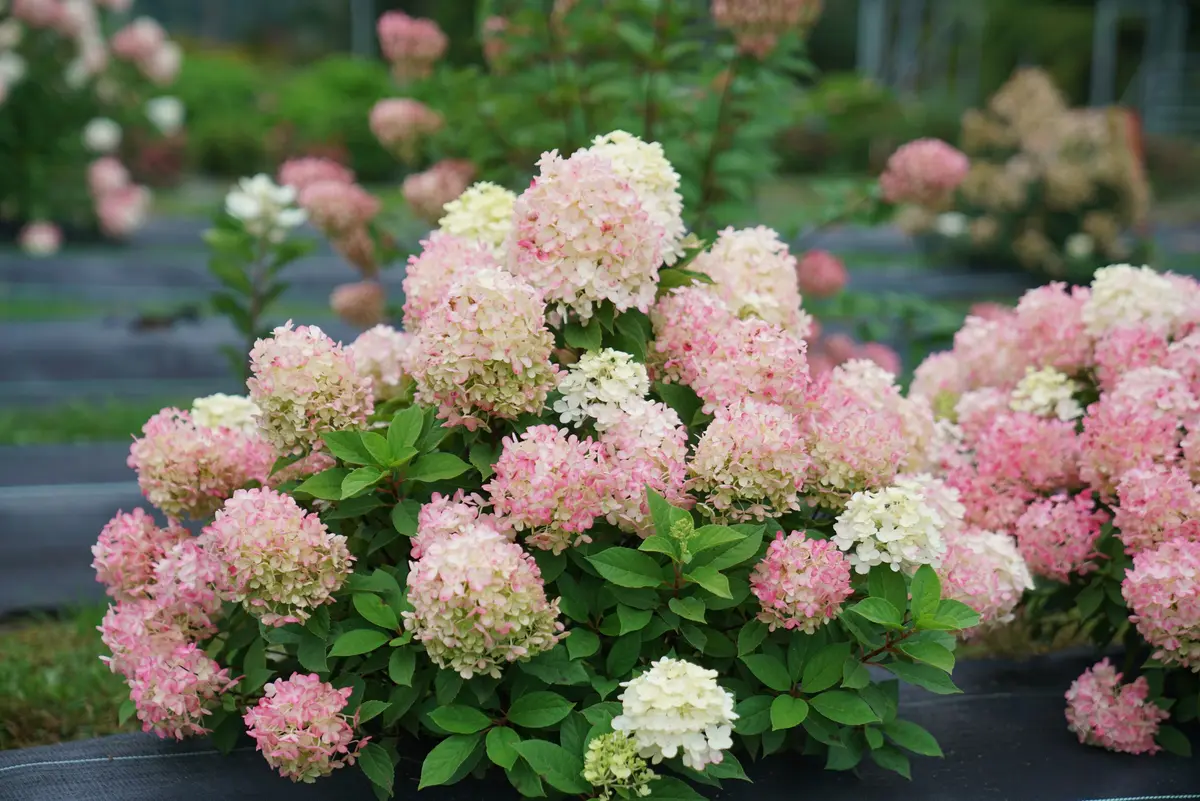
Panicle Hydrangea 'Fire Light Tidbit'
Hydrangea paniculata 'Fire Light Tidbit®'
A dwarf panicle hydrangea forming a 2–3 ft mound with white summer flowers that age pink and red.
Keep reading Show less
Fire Light Tidbit is a dwarf panicle hydrangea with sturdy stems and a rounded habit suited to small beds, borders, and containers.
Through the seasons
Full white flower clusters open in summer and develop pink and red tones as they age. Fall foliage adds color after the main flower display.
Care tips
Plant in full to part sun with well-drained soil and consistent moisture. Mulch the shallow roots. It flowers on new growth; shorten stems by about one-third in late winter or early spring if shaping is needed.
Sources: Proven Winners, NC State Extension, ASPCA: hydrangea.
Fun Fact
Unlike many bigleaf hydrangeas, its flowers age pink and red regardless of soil pH.
Habitat & form
Where it's from and what to expect.
- Native range
- Eastern and southern China, Japan, Sakhalin and Taiwan (species); cultivated selection
- Plant type
- Shrub · Perennial
- Mature size
- 2–3 ft tall and about 3 ft wide at maturity.
- Bloom
- Full white mophead panicles in early to mid summer that age to rich pink and red, staying colorful until frost.
- Hardiness
- USDA zones 3–9.
Care
How to keep it happy.
- Sunlight
- Full sun to part sun (about 4+ hours of direct light). Morning sun with some afternoon shade keeps flowers fresher in hot climates.
- Water
- Average, consistent moisture; mulch to keep the shallow roots cool and even. Water deeply during dry spells, especially in the first year or two.
- Soil
- Average, well-drained soil of almost any pH (acidic, neutral or alkaline). Avoid soggy sites.
- Fertilizer
-
Use slow-release shrub fertilizer only when soil is nutrient-deficient.
As spring growth begins
- Planting distance
- About 3 ft apart for a low border or mass planting; allow 3 ft of width for a single plant.
- Propagation
- Take softwood stem cuttings in early summer.
- Pruning
- Blooms on new wood, so it can be cut back by about one-third in late winter or early spring before growth starts. Deadheading is not necessary.
- Pet safety
- Mildly toxic
Keep pets from eating leaves or flowers.