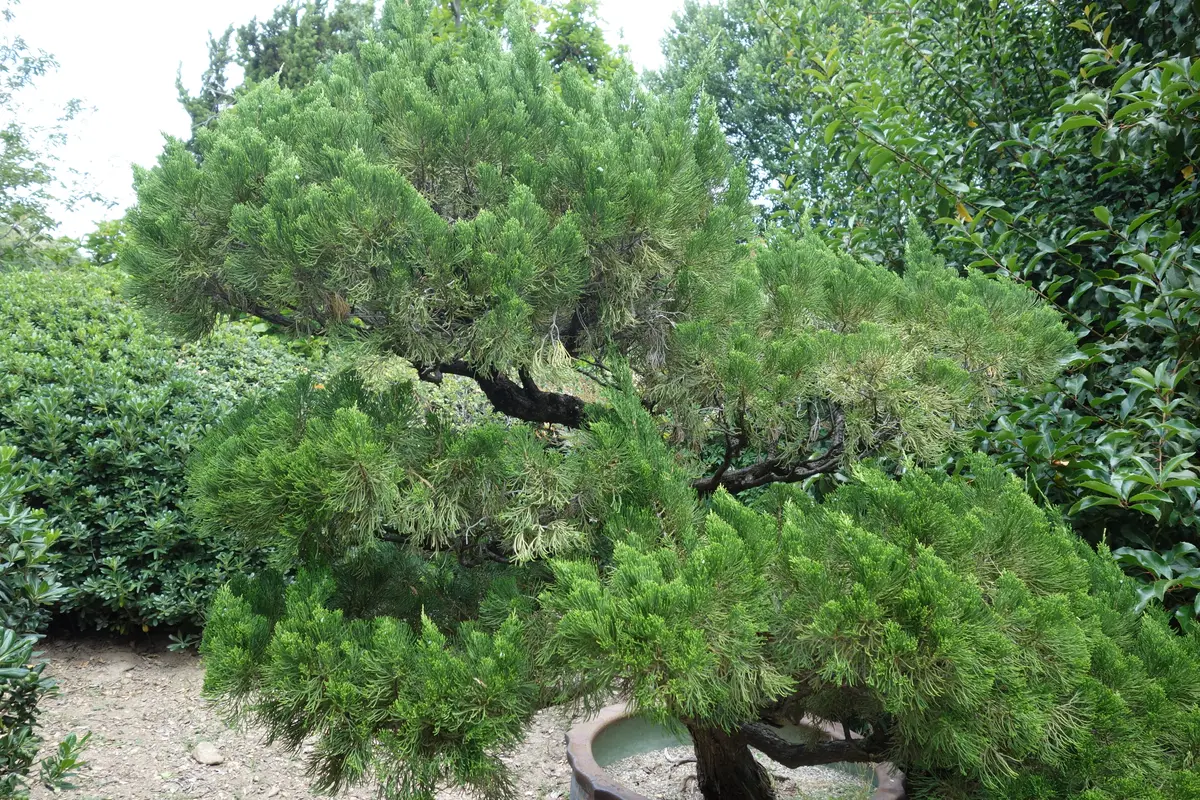
Hollywood Juniper
Juniperus chinensis 'Torulosa'
A sculptural evergreen prized for its irregular, twisted branches and puffy tufts of foliage — living topiary that needs no shears.
Keep reading Show less
Hollywood juniper is an upright evergreen conifer in the cypress family, grown not for flowers but for its irregular, sculptural form: slightly twisted branches carry dense, puffy clusters of scale-like foliage that read almost like a living topiary. Introduced to the U.S. from Japan in the 1920s, it became a signature plant of mid-century Southern California landscaping — hence the common name.
Through the seasons
The bright to dark green, scale-like foliage stays attractive year-round, with no real seasonal change beyond the slow thickening of its sculptural branches. As a dioecious conifer, female plants may bear small, whitish-blue, berry-like seed cones that deepen to a violet-brown over about two years, though the plant’s real appeal is its form rather than any bloom or fruit display.
Care tips
Give this juniper full sun and well-drained soil and it will largely take care of itself — it tolerates heat, drought, salt spray, alkaline soil, and poor urban conditions once established, and rarely needs pruning beyond the occasional removal of dead wood. Because its irregular, twisting silhouette is the whole point, avoid shearing it into a formal shape; that flattens the very character that makes it a “Hollywood” juniper. Its irregular growth also makes it a poor choice for a tight hedge — plant it instead as a specimen, an accent near a gate or entrance, or a focal point in an Asian- or Mediterranean-style garden.
Heads up: The one thing this plant won’t tolerate is wet feet. Avoid low spots where water collects, and skip the daily watering habit favored by more moisture-loving plants nearby.
Fun Fact
Hollywood juniper is also sold under the cultivar name 'Kaizuka'.
Habitat & form
Where it's from and what to expect.
- Native range
- China, Japan, Mongolia, and the Himalayas (species); this twisted-branch selection was introduced to the U.S. from Japan in 1920
- Plant type
- Tree · Shrub · Perennial · Conifer
- Mature size
- 15–30 ft tall and 10–15 ft wide at maturity, though size varies considerably by plant.
- Bloom
- Non-flowering conifer. Tiny, berry-like blue-green seed cones appear on female plants and mature to violet-brown over two years.
- Hardiness
- USDA zones 4–9.
Care
How to keep it happy.
- Sunlight
- Full sun for the densest foliage and strongest form; tolerates part sun.
- Water
- Water regularly while establishing; drought tolerant once mature. Avoid consistently wet or poorly drained sites.
- Soil
- Adaptable to many soils, including clay and alkaline ground, as long as it drains well — wet, soggy soil invites root rot.
- Fertilizer
- No routine fertilizer for healthy, established plants.
- Planting distance
- 8–12 ft apart if planting more than one; more often used as a single specimen.
- Propagation
- Semi-hardwood cuttings in summer or fall; named cultivars don't come true from seed.
- Pruning
- Remove dead wood or trim lightly for size. Avoid shearing; the irregular form develops naturally.
- Pet safety
- Unknown
Prevent chewing; contact a veterinarian after ingestion.