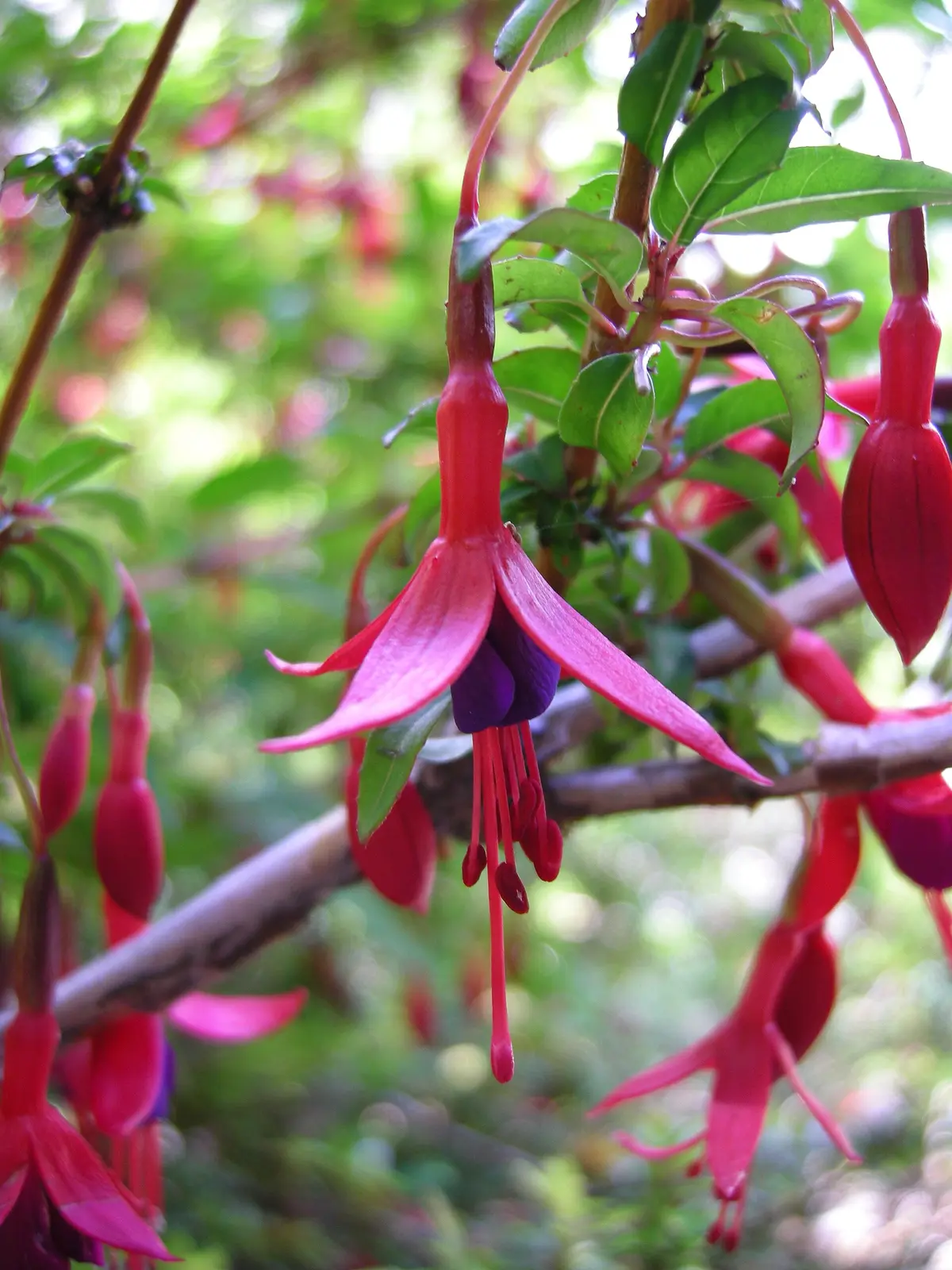
Hardy Fuchsia
Fuchsia magellanica
A graceful, fountain-shaped shrub festooned with dangling scarlet-and-purple lantern flowers from summer through first frost — the hardiest of the fuchsias and an irresistible draw for hummingbirds.
Keep reading Show less
Fuchsia magellanica — Hardy Fuchsia, Magellan Fuchsia, or Hummingbird Fuchsia — is a deciduous to semi-evergreen shrub in the evening primrose family (Onagraceae), native to the cool, moist forests of southern South America, from Peru and Chile south to Tierra del Fuego. It is the hardiest species in the large Fuchsia genus, capable of surviving USDA zone 5 winters when mulched, making it the go-to choice for gardeners in northern climates who want the distinctive fuchsia flower without growing it as a tender annual.
Lantern flowers from summer to frost
The genus honors Leonhart Fuchs (1501–1566), a German physician and herbalist, and the flowers are every bit as theatrical as their name suggests. Each bloom is a pendulous, two-part structure: reflexed scarlet-red sepals flair backward to reveal a nodding tube of rich purple-violet petals, below which hang long, elegant stamens and a pistil. They are produced continuously and prolifically from early summer through the first hard frost, transforming the arching stems into cascades of color. Hummingbirds home in on the nectar-rich flowers as reliably as any feeder; bees and other pollinators follow. Small, dark, juicy berries ripen after the flowers.
Care tips
Hardy Fuchsia thrives in cool, moist conditions with dappled or partial shade — it tolerates full sun where summers are cool and humid, but afternoon shade is advisable in hot climates. Give it fertile, humus-rich soil and consistent moisture; it does not like drought, and it will wilt and decline in dry soil. Mulch generously to conserve moisture, cool the roots, and insulate them over winter.
In zones 5–6, the top growth is typically killed by frost but the roots survive under mulch and resprout vigorously in spring. In these climates, treat the dead stems as a late-spring cleanup task: wait until after the last frost date, confirm new growth is emerging from the base, and cut the old stems to the ground. In milder climates where stems survive the winter, prune hard in early spring to rejuvenate the plant and maximize the summer flower display.
Fun Fact
The vivid pink-purple color called 'fuchsia' was named after this plant — a synthetic aniline dye produced in 1859 was christened 'fuchsine' because its hue matched the flowers so closely. In parts of western Ireland and New Zealand, Fuchsia magellanica has naturalized so thoroughly that it grows wild as tall roadside hedging, looking entirely native — a South American shrub that has convincingly impersonated part of the local landscape for over a century.
Habitat & form
Where it's from and what to expect.
- Native range
- South America: Peru, Chile, Argentina, and Tierra del Fuego
- Plant type
- Shrub
- Mature size
- 5–10 ft tall and wide in mild climates. In zones 5–6, dies to ground each winter and regrows to 3–5 ft by late summer.
- Bloom
- Pendulous, tubular flowers with reflexed scarlet sepals and purple petals and prominent long stamens, produced in abundance from early summer through first frost. Small dark berries follow.
- Hardiness
- USDA zones 5–10. In zones 5–6, tops die back to the ground each winter; roots are hardy with a protective layer of mulch.
Care
How to keep it happy.
- Sunlight
- Dappled shade to partial shade preferred. Tolerates full sun in cool, moist climates but may wilt in afternoon heat; shade it from harsh midday sun in warm regions.
- Water
- Consistent moisture; prefers cool, moist conditions. Does not tolerate drought or waterlogging. Water regularly and mulch to retain moisture.
- Soil
- Fertile, humus-rich, well-drained soil. Tolerates heavy clay with good amendments. High organic matter preferred; wide pH range.
- Planting distance
- 3–5 ft apart (up to 5–10 ft in mild climates where the top doesn't die back).
- Propagation
- Stem cuttings in late summer
- Pruning
- In cold climates: cut dead stems to the ground in early spring after frost danger passes. In mild climates: prune hard in early spring to rejuvenate. Remove dead wood anytime.
- Pet safety
- Non-toxic