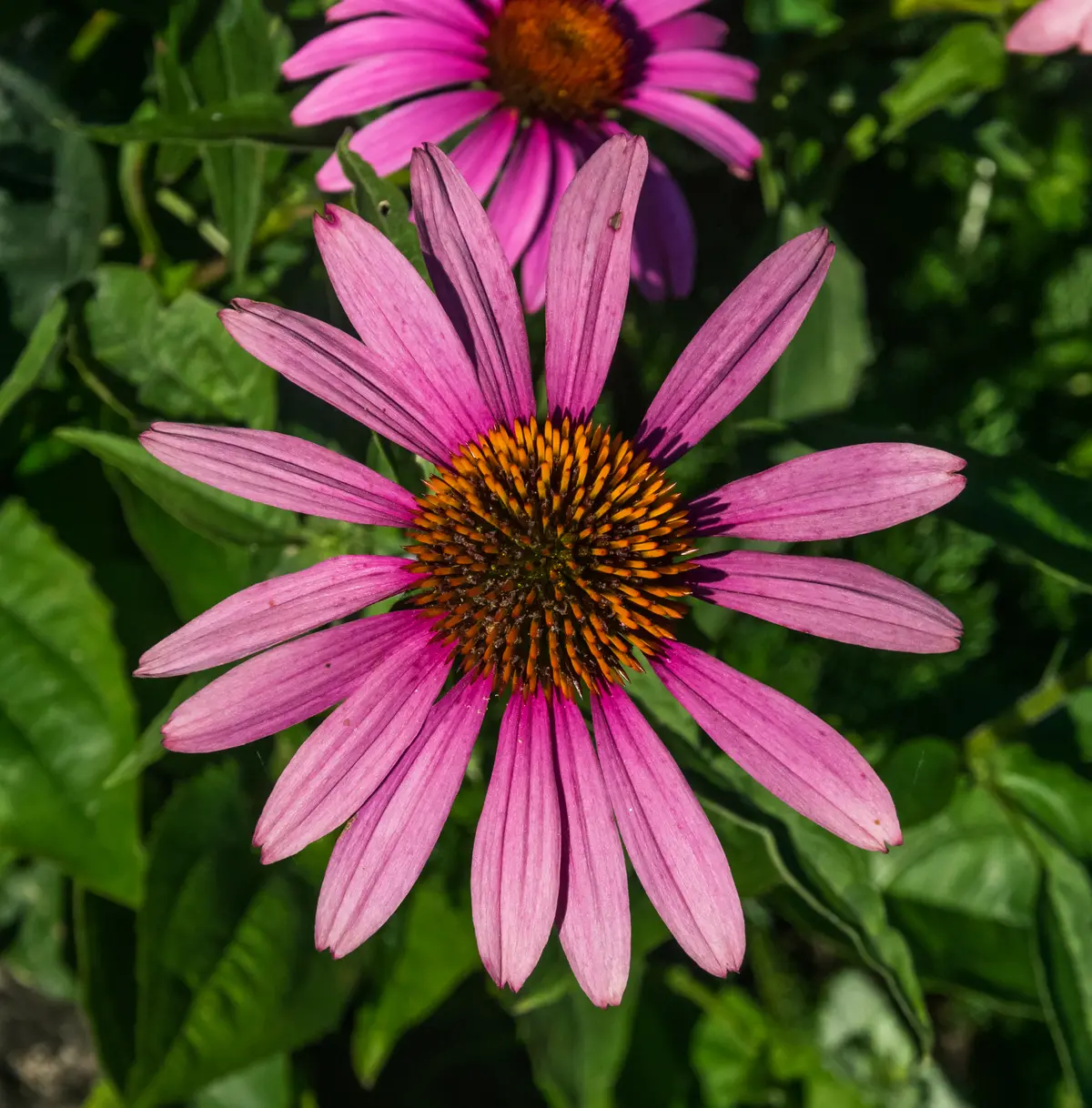
Purple Coneflower
Echinacea purpurea
A tough, long-blooming native prairie perennial with pinkish-purple daisy flowers around a spiny, brown-orange cone.
Keep reading Show less
Purple coneflower is a sturdy, long-blooming herbaceous perennial in the daisy family (Asteraceae), native to prairies, meadows, and open woods across central and eastern North America. It’s one of the most reliable native perennials for a sunny border, forming upright clumps of coarse, rough-textured leaves topped by daisy-like flowers from early summer well into fall.
Through the seasons
The pinkish-purple ray petals droop slightly around a raised, spiny, brownish cone of tiny disc flowers — the source of the genus name Echinacea, Greek for “hedgehog” or “sea urchin.” Each flower lasts for weeks, and established clumps rebloom steadily if deadheaded. Left alone, the cones ripen into seed heads that goldfinches and other birds visit through fall and winter.
Care tips
Purple coneflower tolerates heat, humidity, drought, and a wide range of soils once established, asking for little beyond full sun and decent drainage. It self-seeds readily, so expect volunteer seedlings nearby — thin them out or let a natural drift form. In late winter, cut the previous year’s dead stems back to about 12–24 inches rather than to the ground; native bees overwinter and nest inside the hollow stems, so leaving that stubble standing (even loosely piled nearby) supports them until they naturally break down.
Heads up: Purple coneflower is a magnet for pollinators, especially butterflies, and its seed heads are a favorite of finches — leave a few flower heads unclipped each season if you want the birds to visit.
Fun Fact
Its genus name comes from the Greek word for "hedgehog" — a nod to the spiny, bristling cone at the center of every flower.
Habitat & form
Where it's from and what to expect.
- Native range
- Central and eastern United States
- Plant type
- Perennial
- Mature size
- 2–4 ft tall and 1.5–2 ft wide.
- Bloom
- Pinkish-purple ray petals surround a dark purplish-brown cone from early summer through mid-fall.
- Hardiness
- USDA zones 3–8.
Care
How to keep it happy.
- Sunlight
- Full sun to part shade — blooms best with 6+ hours of direct sun.
- Water
- Medium water needs while establishing; drought tolerant once mature.
- Soil
- Adaptable to clay, loam, or sand. Prefers well-drained soil but tolerates poor, rocky ground.
- Planting distance
- 18–24 in apart.
- Propagation
- Readily grown from seed and will reseed itself in the garden; can also be divided in spring.
- Pruning
- Deadhead to prolong bloom, or leave spent flower heads standing through fall for the seeds — goldfinches and other birds feed on them. Cut the dead stems back to 12–24 in in late winter, and leave the cut pieces nearby a while longer; native bees nest in the hollow stems.
- Pet safety
- Non-toxic