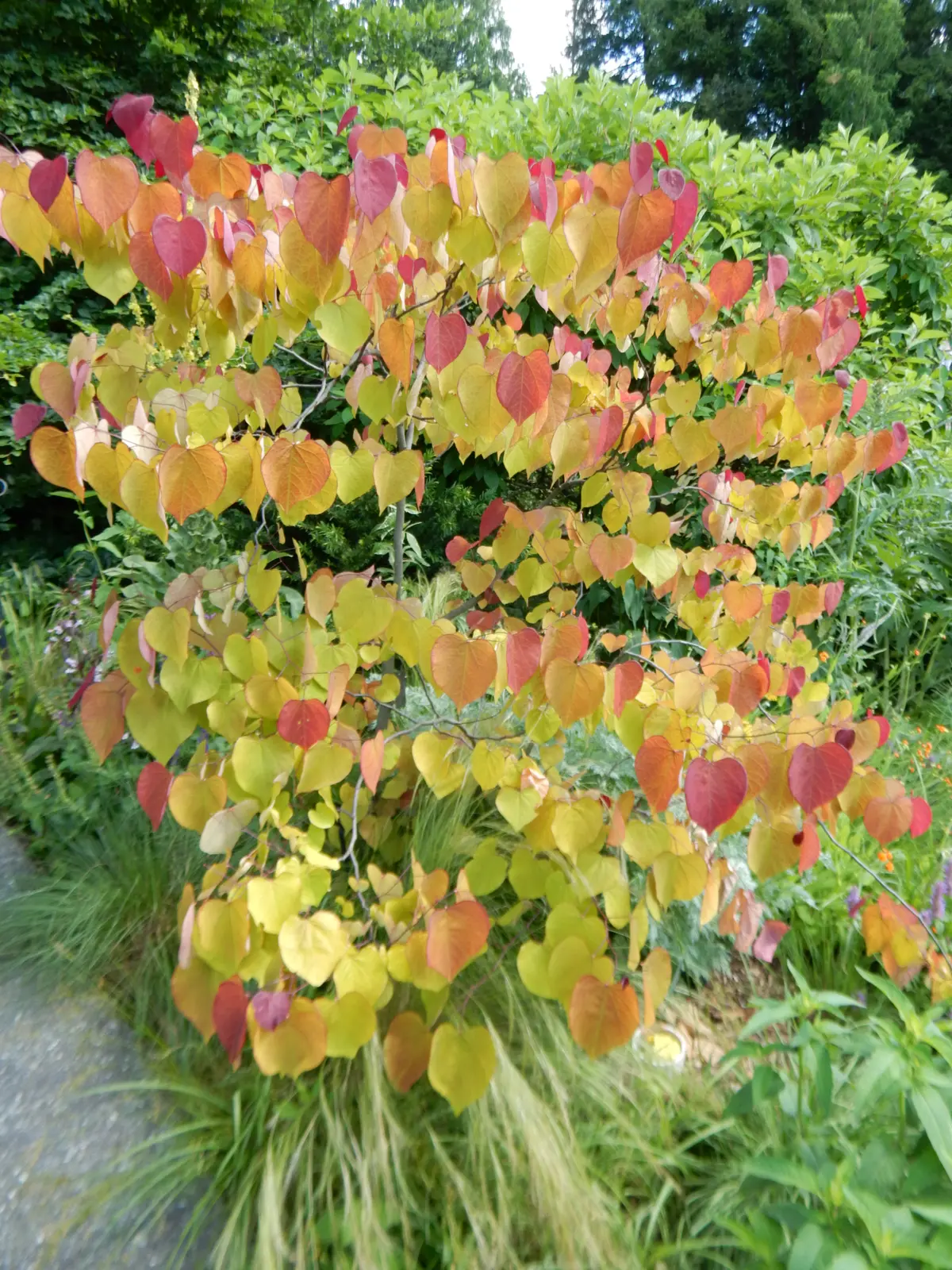
Flame Thrower Redbud
Cercis canadensis Flame Thrower® ('NC2016-2')
A redbud cultivar bred at NC State whose heart-shaped leaves cycle through purple, red, orange, and yellow-green all season, giving the whole tree a fiery, multicolor look.
Keep reading Show less
Cercis canadensis Flame Thrower® is a redbud cultivar bred by Dennis J. Werner at North Carolina State University, created by crossing ‘The Rising Sun’ (a non-weeping, gold-leaf redbud) with a weeping, purple-leaf seedling known as ‘NC2006-14’. The resulting selection, ‘NC2016-2’, was introduced commercially as Flame Thrower.
A tree that’s always changing color
Like its native parent species, Flame Thrower opens the spring with clusters of rosy pink-purple, pea-like flowers along its bare branches, before any leaves appear. But its signature feature comes after bloom: each heart-shaped leaf emerges deep purple, quickly shifts to red as it expands, then continues aging through reddish-bronze and finally yellow-green. Because leaves at every stage of that transition are present on the tree simultaneously, the whole canopy displays a shifting, multicolor mix of purple, red, orange, and gold — especially during flushes of active growth in spring and early summer. The effect fades a bit as summer heat sets in after mid-July.
Care tips
Give Flame Thrower full sun to part shade — full sun brings out the most vivid leaf color — and well-drained soil of average fertility across a range of pH. It shows a gentle pendant habit but isn’t a true weeper, reaching 15–20 ft tall and 10–15 ft wide. Like all redbuds, it resents being transplanted once established, so pick its permanent spot carefully. Prune only lightly, just after flowering, to shape the tree or remove dead and crossing wood.
Fun Fact
Flame Thrower was bred at North Carolina State University by crossing 'The Rising Sun' (gold-leaf) with a weeping purple-leaf seedling. Because every leaf on the tree is at a different stage of its purple-to-red-to-yellow color transition at once, the whole canopy looks like it's on fire, especially in the flush of new growth through early summer.
Habitat & form
Where it's from and what to expect.
- Native range
- Eastern and central North America (species); cultivar bred at NC State University
- Plant type
- Tree
- Mature size
- 15–20 ft tall and 10–15 ft wide, with a slight pendant habit (non-weeping).
- Bloom
- Abundant rosy pink-purple, pea-like flowers in clusters on bare branches in early spring, before leaf-out.
- Hardiness
- USDA zones 5–9.
Care
How to keep it happy.
- Sunlight
- Full sun to part shade; best leaf color develops in full sun.
- Water
- Average moisture; water regularly while establishing, then tolerates occasional dry spells once its roots are deep.
- Soil
- Adaptable to most well-drained soils across a range of pH; dislikes constantly wet or compacted ground.
- Planting distance
- 10–15 ft apart, based on mature spread.
- Propagation
- Not applicable
- Pruning
- Maintenance: low. Prune lightly to shape and remove dead or crossing wood right after flowering. Redbuds dislike being transplanted, so choose the planting site carefully.
- Pet safety
- Non-toxic