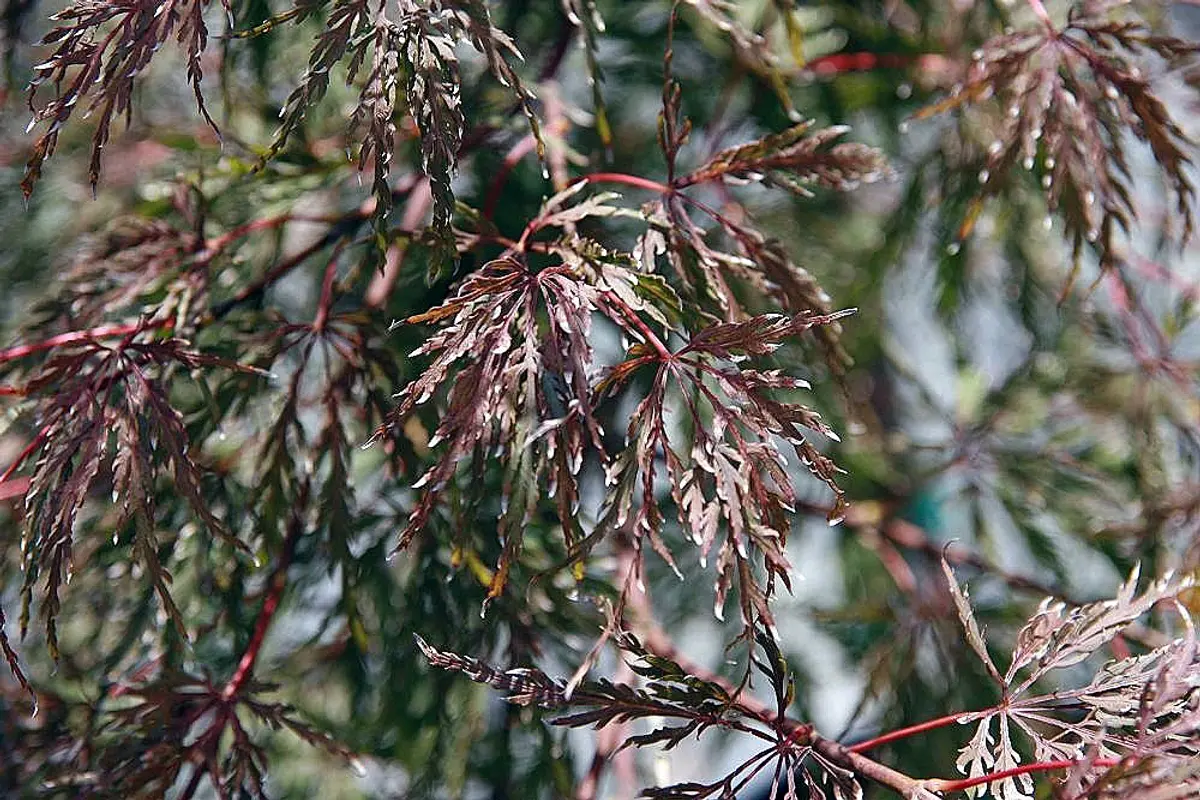
Japanese Maple 'Tamukeyama'
Acer palmatum 'Tamukeyama'
A vigorous weeping laceleaf Japanese maple with deeply dissected crimson foliage that resists summer fade and cascades into a broad, graceful mound — one of the most heat-tolerant red cutleaf maples.
Keep reading Show less
Acer palmatum ‘Tamukeyama’ is a weeping laceleaf (dissectum) Japanese maple grown for combining vigor and toughness with the delicate grace of a cutleaf maple. Its deeply dissected, thread-like leaves emerge and hold a deep crimson-purple through the growing season — resisting the mid-summer fade to green that troubles many red laceleafs — before finishing bright scarlet in autumn.
Built for heat
Among red cutleaf maples, ‘Tamukeyama’ is one of the most heat- and humidity-tolerant, which has made it a favorite far beyond its cool-climate cousins. It grows more vigorously than many laceleafs, its branches arching over into a broad, cascading mound that typically reaches 6–8 feet tall and 8–12 feet wide over many years.
A specimen for any garden
Its weeping, mushroom-like form makes it a natural focal point — near a patio, at the edge of a border, in a rock garden, or beside a pond where the cascading branches can reflect in the water. It layers beautifully as an understory tree beneath taller canopy that provides the dappled shade it prefers, and it is generally left alone by deer.
Fun Fact
'Tamukeyama' is one of the oldest named laceleaf maples still grown — it dates to around 1710, when it appeared in the first published catalogue of Japanese maple cultivars. It is prized for holding its deep crimson-purple color through summer heat and humidity far better than most red cutleaf maples, which is why it thrives in the American South where others fade to bronze-green.
Habitat & form
Where it's from and what to expect.
- Native range
- Japan, Korea, and China
- Plant type
- Tree
- Mature size
- 6–8 ft tall and 8–12 ft wide at maturity; slow-growing, broad weeping mound.
- Bloom
- Small, inconspicuous reddish-purple flowers in spring, followed by ornamental winged samaras. Grown primarily for its foliage and form.
- Hardiness
- USDA zones 5–8.
Care
How to keep it happy.
- Sunlight
- Dappled shade to part sun; tolerates more sun than most red laceleafs. Protect from hot afternoon sun and drying winds in warm regions to prevent leaf scorch.
- Water
- Regular; prefers consistently moist but well-drained soil. Avoid drought stress and waterlogging, which scorch the fine foliage.
- Soil
- Rich, loamy, and well-drained with high organic matter; slightly acidic pH preferred. Mulch to retain moisture and keep the shallow roots cool.
- Planting distance
- 8–12 ft apart as a specimen, based on mature spread.
- Propagation
- Not applicable
- Pruning
- Minimal pruning needed. Remove dead or crossing branches in late winter while dormant; avoid heavy or late-season cuts, which bleed.
- Pet safety
- Non-toxic